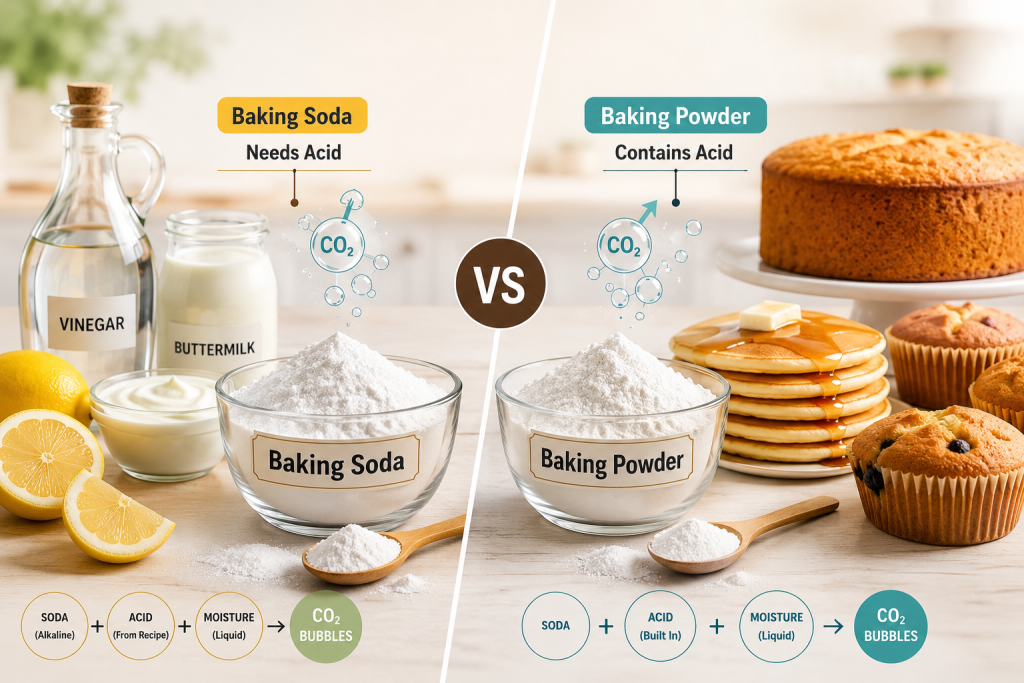
Baking powder and baking soda look almost the same, but they do not work the same way. Many people confuse them because both are white powders used in baking, and both help cakes, biscuits, muffins, and pancakes rise. The difference matters because using the wrong one can affect the taste, texture, colour, and rise of your recipe.
Understanding baking powder vs baking soda is useful even if you only bake occasionally. Once you know how each one works, it becomes much easier to follow recipes correctly and avoid flat cakes, bitter biscuits, or dense muffins. The simple rule is that baking soda needs acid, while baking powder already contains acid.
What Is Baking Soda?
Baking soda is pure sodium bicarbonate. It is an alkaline ingredient, which means it needs an acidic ingredient and moisture to activate. When baking soda reacts with acid, it creates carbon dioxide gas, and that gas forms bubbles inside the batter or dough.
Those bubbles help baked goods rise while they cook. This is why baking soda is often used in recipes that include acidic ingredients like buttermilk, yoghurt, lemon juice, vinegar, cocoa powder, brown sugar, honey, or cream of tartar. Without enough acid, baking soda may not react properly.
Baking soda is also stronger than baking powder, so recipes usually need only a small amount. If too much is used, or if there is not enough acid to balance it, the final result can taste bitter, metallic, or soapy. That is why measuring it carefully is important.
What Is Baking Powder?
Baking powder is a complete leavening agent. It usually contains baking soda, an acid, and a dry starch that helps keep the mixture stable. Because it already contains acid, baking powder can work in recipes that do not have many acidic ingredients.
Most baking powder sold today is double acting. This means it reacts once when it becomes wet and again when it is heated in the oven. That two stage reaction gives baked goods a steadier rise and makes baking powder useful for cakes, muffins, pancakes, scones, and quick breads.
Baking powder is often used when a recipe needs lift but does not include ingredients like buttermilk, yoghurt, vinegar, or lemon juice. It is easier to use in simple recipes because the acid is already built in. That is the main reason baking powder appears in so many everyday baking recipes.
Baking Powder vs Baking Soda: The Main Difference
The main difference between baking powder vs baking soda is how they activate. Baking soda needs an acidic ingredient to create a proper reaction, while baking powder already contains the acid it needs. This makes baking powder more complete and baking soda more dependent on the rest of the recipe.
Baking soda is more powerful, but it must be balanced correctly. Baking powder is less powerful, but it is more flexible because it can work without extra acidic ingredients. This is why you cannot simply swap them in equal amounts and expect the same result.
If a recipe calls for baking soda, it usually means there is already acid in the ingredients. If a recipe calls for baking powder, it usually means the recipe needs lift without relying on much acidity. The recipe writer has already balanced the chemistry, so it is best to follow the ingredient listed.
When To Use Baking Soda
Use baking soda when your recipe contains acidic ingredients. Common examples include banana bread with brown sugar, chocolate cake with cocoa powder, pancakes with buttermilk, or muffins made with yoghurt. In these recipes, the acid activates the baking soda and helps the batter rise.
Baking soda also helps baked goods brown more deeply. Cookies made with baking soda often spread more and develop a richer golden colour. This is one reason many cookie recipes use baking soda instead of baking powder, or sometimes use both.
Because baking soda reacts quickly once liquid and acid are added, the batter should usually be baked soon after mixing. If the batter sits for too long, some of the gas can escape before baking starts. This can lead to a flatter result.
When To Use Baking Powder
Use baking powder when your recipe does not contain much acid or when you need a controlled, even rise. Plain cakes, pancakes, muffins, scones, and sponge style recipes often use baking powder because it gives lift without needing strongly acidic ingredients.
Baking powder is also useful when the flavour needs to stay mild. If a recipe used lemon juice, vinegar, or buttermilk only to activate baking soda, it could change the taste. Baking powder avoids that problem because it already contains the acid needed for the reaction.
If a recipe says baking powder, use baking powder. It has likely been tested with that ingredient in mind. Changing it to baking soda without adjusting the rest of the recipe can affect the flavour, rise, and texture.
Why Some Recipes Use Both
Some recipes use both baking powder and baking soda because each one has a different job. Baking soda reacts with the acidic ingredients in the recipe, while baking powder adds extra lift. This combination can improve the rise, texture, colour, and flavour.
For example, a chocolate muffin recipe may include cocoa powder and yoghurt. The baking soda reacts with the acid in those ingredients, while baking powder helps the muffin rise more evenly. Together, they create a soft and balanced result.
This is common in cakes, muffins, pancakes, and some biscuit recipes. If both are listed, do not remove one unless you understand how the recipe is built. The balance is there for a reason.
Can You Substitute Baking Powder for Baking Soda?
You can sometimes substitute baking powder for baking soda, but it is not a perfect swap. Baking soda is much stronger than baking powder, so you usually need about three times as much baking powder to replace baking soda.
For example, if a recipe calls for 1 teaspoon of baking soda, you may need around 3 teaspoons of baking powder. This can work in some simple recipes, but it may change the taste and texture because baking powder contains added acid and starch.
The better option is to use the ingredient the recipe asks for. Substitutions are useful in an emergency, but they are not always reliable. Baking depends on balance, and small changes can make a big difference.
Can You Substitute Baking Soda for Baking Powder?
You should not replace baking powder with plain baking soda unless you also add an acid. Baking soda needs acid to activate, and many recipes that use baking powder do not have enough acid on their own.
A common homemade baking powder substitute is 1 quarter teaspoon of baking soda mixed with 1 half teaspoon of cream of tartar. This combination gives the baking soda the acid it needs to work properly. It can replace about 1 teaspoon of baking powder.
Do not use a full teaspoon of baking soda in place of a teaspoon of baking powder. That will usually be too strong and may leave a bitter or unpleasant taste. It may also make the recipe rise too quickly and then collapse.
What Happens If You Use the Wrong One?
If you use baking soda instead of baking powder, your recipe may rise too fast and then sink. It may also taste bitter, soapy, or metallic if there is not enough acid to balance it. This is one of the most common mistakes in home baking.
If you use baking powder instead of baking soda, the recipe may not brown as expected. It may also rise differently because baking powder is weaker than baking soda. The final texture can become dense, dry, or less crisp, depending on the recipe.
This is why baking powder vs baking soda is not just a small pantry detail. It affects the whole structure of baked goods. Cakes, biscuits, muffins, pancakes, and cookies all depend on the right leavening agent.
How To Check If Baking Powder Is Still Fresh
Baking powder can lose strength over time, especially if it has been exposed to moisture. If your baked goods are not rising well, old baking powder could be the reason. Testing it only takes a few seconds.
Place a small spoonful of baking powder into a cup and add hot water. If it bubbles strongly, it is still active. If it barely reacts, it is time to replace it.
Store baking powder in a cool, dry place with the lid closed tightly. Moisture can make it react early and weaken its power. Fresh baking powder gives better and more consistent results.
How To Check If Baking Soda Is Still Fresh
Baking soda usually lasts a long time, but it can still lose freshness or absorb odours from the pantry or fridge. If you are using it for baking, it is worth testing before adding it to an important recipe.
Place a small spoonful of baking soda in a bowl and add vinegar or lemon juice. If it fizzes strongly, it is active. If the reaction is weak, replace it.
For cleaning, slightly older baking soda may still be useful. For baking, freshness matters more because the reaction affects the rise and texture of the food.
Baking Soda for Cleaning
Baking soda is also commonly used for cleaning because it is mildly abrasive and can help absorb odours. It can be useful for light kitchen cleaning, deodorising, and removing mild residue from some surfaces. However, it should still be used carefully because it can scratch delicate materials.
Baking soda can help with fridge smells, greasy spots, and some general cleaning tasks. If you are cleaning larger kitchen areas, you may also find Best4ever’s guide on how to clean an oven useful. It explains practical oven cleaning steps for everyday build up.
For glass surfaces, baking soda is not always the best choice because it can leave residue. If you are working on windows or glass panels, read our guides on how to clean windows and how to clean shower glass. These are better suited for glass cleaning problems.
Is Baking Powder Good for Cleaning?
Baking powder is not the best cleaning choice. It contains baking soda, but it also includes acid and starch. These extra ingredients are useful for baking, but they are not needed for most household cleaning jobs.
If you need a simple cleaning powder, baking soda is usually the better option. It is more direct, more affordable, and does not contain the added ingredients found in baking powder. Still, it should not be treated as a universal cleaner for every surface.
For deeper cleaning, proper products and professional support are often better. Best4ever provides residential cleaning, commercial cleaning, carpet cleaning, and tile and grout cleaning for homes and businesses that need more complete cleaning support.
Common Mistakes To Avoid
One common mistake is using too much baking soda. More does not mean better. Too much baking soda can create a harsh taste, uneven browning, and a poor texture.
Another mistake is using old baking powder. If baking powder has lost strength, your cakes or muffins may come out flat even if the rest of the recipe is correct. Always check the date and test it if you are unsure.
People also make the mistake of letting baking soda batter sit too long. Since baking soda reacts quickly, it is usually better to bake the mixture soon after mixing. This helps keep the gas bubbles inside the batter where they can help with rise.
Quick Rule To Remember
Use baking soda when the recipe includes acidic ingredients like buttermilk, yoghurt, lemon juice, vinegar, cocoa powder, honey, or brown sugar. Baking soda needs acid to work properly, and it is best when the recipe has enough acidity to balance it.
Use baking powder when the recipe needs lift but does not contain much acid. Baking powder already has the acid it needs, which makes it suitable for many cakes, muffins, pancakes, and scones.
Use both only when the recipe asks for both. In that case, baking soda and baking powder are doing different jobs. Removing one can change the final result.
Final Thoughts
The difference between baking powder vs baking soda comes down to chemistry. Baking soda is pure sodium bicarbonate and needs acid to activate. Baking powder already contains acid, so it can work in recipes without many acidic ingredients.
Baking soda is best for recipes with buttermilk, yoghurt, lemon juice, vinegar, cocoa, honey, or brown sugar. Baking powder is better for recipes that need a steady rise without extra acidity. Both are useful, but they are not interchangeable in equal amounts.
For cleaning, baking soda is usually more useful than baking powder, but it still has limits. If your home or business needs more than quick kitchen fixes, Best4ever can help with practical cleaning support. Visit our services page or contact us to learn more.